Younes Boulaguiem
Younes Boulaguiem, PhD

Statistical Scientist

“In God we trust. All others must bring data.”
— W. Edwards Deming

I am interested in understanding biological mechanisms, and in the statistical work that makes those questions answerable: how diseases progress, how treatments act, why patients respond differently, and which models can reflect the underlying biology closely enough to separate signal from noise.

I first joined Roche (Basel Headquarters) as a research intern, applying latent variable models to disability endpoints in neuroinflammatory diseases, and returned full-time to a translational and exploratory biomarker team, where my current focus is haemophilia and gene therapy. I use molecular and clinical data to characterise mechanisms of action, understand response heterogeneity, and identify biomarkers that help guide the development of new therapies. I also support clinical studies as a trial statistician, contributing to study design, interim analyses, and decision rules.

Across both, the aim is evidence that holds up where it matters: in decisions about which patients, which endpoints, and whether to continue.

Before that, I was a postdoctoral researcher at the Clinical Research Center of the Geneva University Hospitals (HUG), where I led multi-study meta-analyses of survival data across European clinical registries, developing inference strategies for heterogeneous data. In parallel, I was the main statistician on longitudinal cohort studies of early predictors of Alzheimer’s disease and protective factors against amyloid accumulation. I hold a PhD in Statistics from the University of Geneva (co-advisors: Prof. Maria-Pia Victoria-Feser and Prof. Stéphane Guerrier), where I developed new methods for bioequivalence testing, designed a generative AI model for spatial extremes, and contributed to simulation-based privacy-preserving inference techniques.

Overall, my work bridges statistical innovation and practical impact, with over seven publications, ten talks, and open-source tools that foster reproducible and collaborative research in statistics and machine learning.

Download CV

Experience

  1. Statistical Scientist

    Roche
    • Translational & exploratory biomarkers: molecular and clinical data to characterise mechanisms of action, response heterogeneity, and candidate biomarkers guiding new therapies.
    • Trial statistician: study design, interim analyses, and decision rules for clinical studies.
  2. Postdoctoral Researcher in Statistics

    Clinical Research Center, HUG
    • Lead methodologist on multi-study meta-analyses of survival data for hip and knee prosthesis outcomes: built a simulation-based framework to benchmark methods for pooling aggregate survival data across European prosthesis registries, recovering implant-revision risk profiles from reported Kaplan–Meier estimates while adjusting for case-mix heterogeneity between source populations.
    • Main statistician on longitudinal cohort studies of early predictors of Alzheimer’s disease and protective factors against amyloid accumulation, using social-cognition and behavioural markers in cognitively healthy individuals.
  3. Research Intern

    Roche
    • Item Response Theory (IRT) modeling for disability endpoints in neurology.
    • Data curation for ongoing trials.
  4. Research Fellow in Statistics

    University of Geneva
    • Developed novel bioequivalence testing methods, published in Statistics in Medicine (two first-author papers, here and here), implemented in the cTOST R package.
    • Created evtGAN, a generative AI model for spatial extremes (first-author in Environmental Data Science). Open-source material available in Zenodo.
    • Designed simulation-based inference methods under differential privacy (view pre-print).
    • Contributed to 7+ publications, 10+ talks, and R Shiny dashboards for drug data visualization.
  5. Teaching Assistant

    University of Geneva
    • Led tutorials, lectures and supervised master theses for undergraduate and graduate courses in Statistics, Probability, and Mathematics.
    • Created interactive e-book and a private YouTube channel for R tutorials for the course Mixed Linear Models.

Education

  1. PhD in Statistics

    University of Geneva

    Research included:

    • Bioequivalence.
    • Simulation-based Inference.
    • Differential Privacy.
    • Generative AI & Computer Vision.
    • Extreme Value Theory.
    • Pharmaceutics.
    View Presentation
  2. MSc in Statistics

    University of Geneva

    Thesis: Learning Max-stable Distributions with Generative Adversarial Networks. Advisor: Prof. Sebastian Engelke.

    Grade: 5.5/6

  3. BSc in Economics

    HEC Lausanne
Publications
(2026). Impact of intelligence on social cognition in mentally disordered offenders: preliminary evidence in schizophrenia and personality disorders. Frontiers in Psychology.
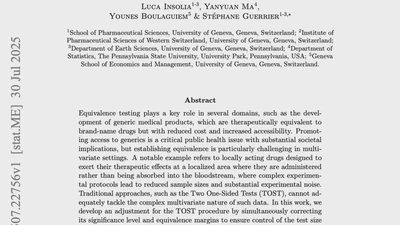
(2025). Bioequivalence Assessment for Locally Acting Drugs: A Framework for Feasible and Efficient Evaluation. arXiv.
(2025). Fiducial Matching: Differentially Private Inference for Categorical Data. arXiv.
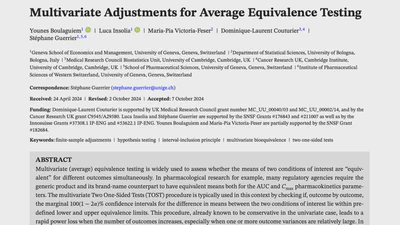
(2025). Multivariate Adjustments for Average Equivalence Testing. Statistics in Medicine.
(2024). Patient-Perceived Impact of the COVID-19 Pandemic on Medication Adherence and Access to Care for Long-Term Diseases: A Cross-Sectional Online Survey. COVID.
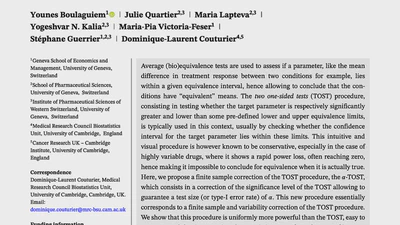
(2023). Finite sample corrections for average equivalence testing. Statistics in Medicine.
(2023). Influence of Molecular Structure and Physicochemical Properties of Immunosuppressive Drugs on Micelle Formulation Characteristics and Cutaneous Delivery. Pharmaceutics.
(2022). Faultlines within Sectors in Partnership Executive Boards. Book chapter.
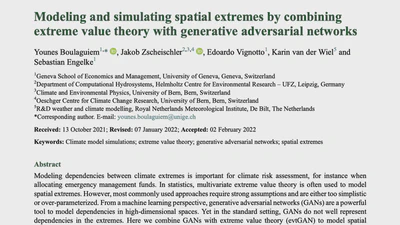
(2022). Modeling and Simulating Spatial Extremes by Combining Extreme Value Theory with Generative Adversarial Networks. Environmental Data Science.
(2021). Polymeric Micelle Formulations for the Cutaneous Delivery of Sirolimus: A New Approach for Treating Facial Angiofibromas in Tuberous Sclerosis Complex. Int. J. Pharm..
DOI
Talks

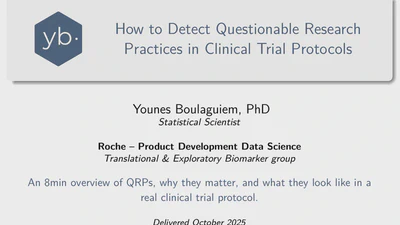
How to Detect Questionable Research Practices in Clinical Trial Protocols

An 8min overview of QRPs, why they matter, and what they look like in a real clinical trial protocol.

avatar
Younes Boulaguiem

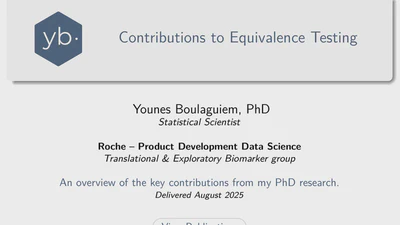
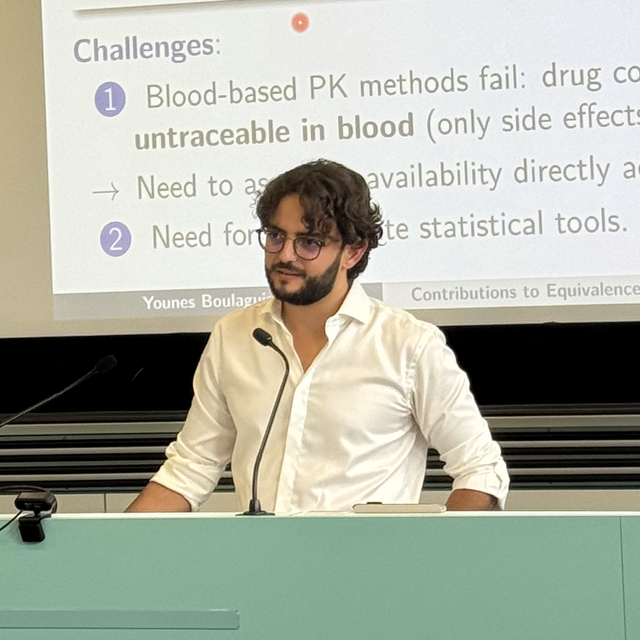
Contributions to Equivalence Testing

This talk presents improved finite-sample corrections for equivalence testing, offering better calibration and power than standard methods.

avatar
Younes Boulaguiem

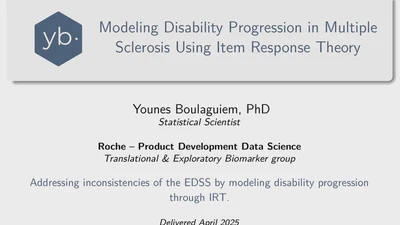
Modeling Disability Progression in Multiple Sclerosis Using Item Response Theory

A short overview of why the EDSS is limited and how Item Response Theory might provide a more sensitive approach to modeling disability progression in MS.

avatar
Younes Boulaguiem

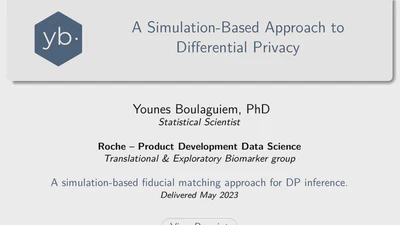
A Simulation-Based Approach to Differential Privacy

An introduction to DP-JIMI, a simulation-based approach to inference under differential privacy.

avatar
Younes Boulaguiem

A 15min Introduction to Differential Privacy

A quick, example-driven overview of differential privacy and how mechanisms like Laplace noise provide strong privacy guarantees with useful accuracy.

avatar
Younes Boulaguiem

A 15min introduction to Edgeworth Expansions

A concise introduction to Edgeworth expansions and how they refine asymptotic approximations in statistics.

avatar
Younes Boulaguiem

Learning Extremes with evtGAN

A hybrid framework combining extreme value theory with GANs to learn and simulate high-dimensional spatial extremes.

avatar
Younes Boulaguiem

A 15min introduction to GANs

A concise introduction to how GANs learn data distributions through adversarial training and why they’re powerful yet hard to train.

avatar
Younes Boulaguiem
Open Source


cTOST R package
CRAN ∙ February 2025
The cTOST R package implements a set of finite-sample corrective procedures that improve the power and accuracy of the widely used Two One-Sided Tests (TOST) method in bioequivalence and clinical research. Developed as part of our Statistics in Medicine (2024) publication, the package provides practical tools that address TOST’s known conservativeness, offering more reliable equivalence conclusions, in particular for highly variable drugs. The accompanying website includes methodological details, examples, and guidance for applying the cTOST procedures in practice.

Explore package →


evtGAN
Zenodo ∙ October 2021

evtGAN is a lightweight emulator that combines extreme value theory (EVT) with generative adversarial networks (GANs) to model rare compound events with far greater accuracy than traditional tools. Climate models are computationally costly, EVT alone struggles with complex spatial dependence, and standard machine-learning models typically fail in the extreme tail. evtGAN overcomes these limitations by separating marginal behavior from dependence using a copula-based framework: EVT provides theoretically sound marginal modeling and tail extrapolation, while GANs flexibly learn spatial dependence patterns. With strong performance even from as few as 30 annual maxima, evtGAN offers scientists an efficient, ready-to-use solution for simulating extremes. The Zenodo repository provides 2'000 years of simulated annual temperature and precipitation maxima over Western Europe, along with R and Python (TensorFlow) code to reproduce the method from our Environmental Data Science (2022) publication.

Explore code & data →

Contact

Let’s work together

Tell me about your project, collaboration idea, or question.